Rui Ueno studied for one year at the University of Montana in the United States through an SAF program during her third year of university. Raised with great care in a family with parents and much older siblings, she attended a traditional private girls’ school from kindergarten through high school. She recalls vaguely imagining a future in which she would follow the stable career path of her family members working at major corporations, then get married and support a household.
Contrary to those expectations, she actually joined a venture company straight out of university. “It’s a common phrase, but studying abroad really broadened my perspectives and my choices,” she says, recalling the experience vividly. What exactly changed the course of her decision-making? And what kind of transformation did studying abroad bring to her world?
At the end of the interview, she shares a message for those who are considering studying abroad or feeling unsure. Her honest advice, shaped by both the challenges and joys she experienced firsthand, will surely resonate with many readers.
Profile of Rui Ueno:
While studying at Japan Women's University (an SAF partner university), she studied abroad at the University of Montana (USA) for one year. After graduating, she worked for two IT companies before accompanying her husband on his US posting in 2021. While living in New Jersey, she worked for a local company that operated a cafe for one year, and then moved to San Jose, California. Currently, while raising her four-year-old child, she is the representative of a PR firm where she handles public relations for a number of major client companies, including Duolingo.
Days Filled With Challenges as She Encountered New Worlds and Values
When did you first become aware of studying abroad as an option?
When I was in high school. I had the opportunity to take short-term study trips to the U.S. and Canada, which sparked my interest.
My parents always wanted me to “be someone who can operate internationally,” and one of my father’s close friends lived in New York, so foreign countries felt familiar. They never opposed the idea—in fact, the atmosphere was more like “You should definitely go.”
There wasn’t a single defining moment, but over time I naturally felt that I wanted to study abroad during university.
Did arranging a long-term study abroad during university go smoothly?
Actually… not at all (laughs).
My grades and TOEFL scores were just barely enough, so my options were basically down to two: the University of Montana or a university in Hawaii. I thought, “I can always visit Hawaii someday, but I might never choose Montana if I don’t go now,” so I decided on Montana.
I am truly glad I chose the University of Montana. Surrounded by nature and away from the noise of big cities, it was the perfect environment to focus on studying. It was also very safe—I never had a frightening experience the entire time.
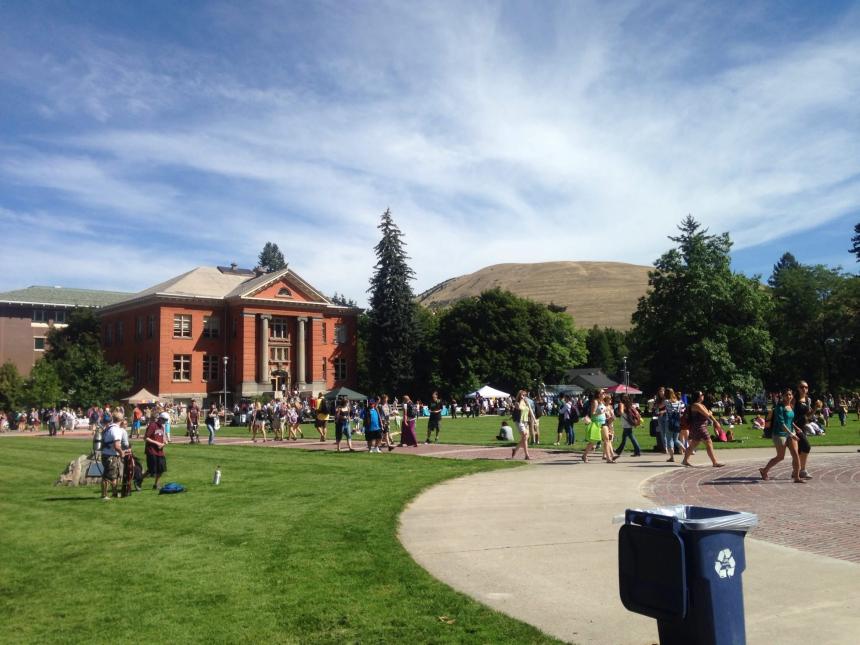
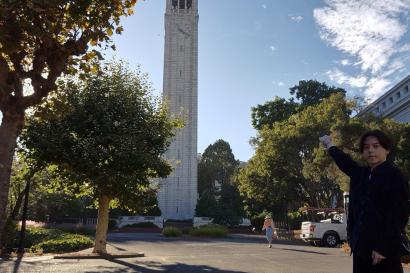
The campus is beautiful, showing completely different faces with each season. The surrounding nature is magnificent, including famous places like Yellowstone National Park and Glacier National Park—on a scale you simply don’t find in Japan.
Since I had lived in Tokyo all my life, it was an incredibly valuable experience to live in a place I probably never would have visited otherwise. For anyone undecided about where to study abroad, I highly recommend it!
Were there any classes or assignments that left a strong impression?
Studying abroad is always a challenge. Taking classes in an unfamiliar place alongside local students can be pretty tough.
One class I remember clearly is Visual Merchandising. We had to create miniature display models for showroom windows, and my classmates and the instructor praised my work a lot.
English was the bigger struggle. I recorded all my lectures because I couldn’t understand them fully. At that time, we didn’t have modern translation tools or ChatGPT—so I was constantly using a digital dictionary.
In my journalism class, we had weekly tests based on The Economist. I spent an entire semester reading, researching, and annotating articles. It really made me think, “I should have studied harder before coming.” But thanks to that class, my English improved dramatically.
Throughout the year, I studied far more, in both volume and depth, than I ever did in Japan. In the US, they give out something like a list of top students at the end of the semester, and I was even able to make it on there. The experience of "doing my best" gave me a lot of confidence.
Encounters and Experiences That Completely Changed Her Sense of “Normal”
Was there any event or encounter that changed your values while abroad?
I feel that you can meet a wide variety of people in America.
I met many people with values and lifestyles that were completely outside of what I had previously considered "normal." Even among Japanese people living in the U.S., many were wonderfully unique in a good way.
Going abroad requires a certain drive and boldness. Most of the people I met had a clear sense of purpose or strong passion.
One moment I’ll never forget are the words of full-time student in his senior year at the time.
I went to all-girls schools from kindergarten to university, and I grew up surrounded by people with similar family backgrounds and ways of thinking. So, I had no doubt that I would end up getting a job at a stable company in the future.
But one day he said to me, “You’re probably suited for a startup.” That was the first time such an option even occurred to me. It definitely had an impact on my career after that, so I think my life would have been completely different if I hadn't studied abroad.
Is there anyone who currently influences you?
Two people.
One is someone I consider a mentor, who taught me everything about PR. They work with a wide range of clients domestically and internationally, and their skill, trustworthiness, and attention to detail always inspire me.
The second is a woman living in Los Angeles who also founded a marketing company. She balances raising two children with her work, and I find her strength and confidence incredibly admirable.
What they share is this: no matter who they’re dealing with, they stay true to themselves and act with confidence.
I’ve always wanted to work using English—not just because of language ability itself, but because challenging myself beyond language barriers opens more opportunities and expands the scope of what I can do.
Seeing people who confront others without fear of language differences and pursue what they love—that’s something I deeply respect and aspire to.
About the Present, the Future, and the Importance of Choosing Your Own Path
How has studying abroad influenced your career?
It was a huge plus during job hunting, and even now, being able to use English greatly expands the range of work I can take on.
In terms of both compensation and work responsibilities, it’s been nothing but an advantage. Not just for work—it's also invaluable in my daily life abroad.
Raising a child and living in a foreign country can be difficult, but having the foundation of study abroad made me capable of handling it. Without that experience, my life would be much harder now. For example, when my child gets sick or when unexpected trouble happens, I feel that I can handle things on my own in any country—and that toughness came from studying abroad.
What would you like to challenge yourself with in the future?
I love working, so I always end up talking about work.....
I am still in the early stages of my work connecting Japan with the world through the medium of PR, but I hope to continue doing this kind of work in the future.
Right now my English skills still have room to grow, so my main work is focused on Japan market entry for foreign companies. But ultimately, I want to help Japanese companies with global ambitions expand overseas. I’m very interested in helping bring Japanese companies and their work to the world.
How is life in San Jose where you currently live?
San Jose is a relatively safe area, and I rarely feel unsafe in my daily life.
(Of course, I try to follow basic safety precautions, such as not going out alone late at night and avoiding places with few people around.)
However, there was a very exceptional incident on the recent Black Friday when gunshots were heard in a shopping mall and people evacuated as a precaution. However, such incidents do not occur on a daily basis, and it was impressive to see how many visitors and security guards responded calmly to the situation.
Through this experience, I once again realized that "no matter how safe an area is said to be, the environment is different from Japan," but at the same time, I learned that if you understand local safety information and take appropriate actions, you can remain safe. From the perspective of a mother, I feel that if you have the necessary preparations and information, you can deal with any situation calmly.
*Note from SAF: In the United States, every region has clear guidelines for what is safe, and universities and local communities frequently provide safety information. Many international students follow these basic rules and enjoy a safe and fulfilling study abroad experience.
How does living in the U.S. compare to living in Japan?
There are countless differences—from loneliness due to being far from family and friends to the cost of living.
Since I was born and raised in Japan, I often feel that Japan is more convenient. I’m also someone who enjoys interacting with people, so yes, I’ve definitely felt lonely at times.
Looking back at my life in Japan, I realize I was always preoccupied with things like “How do others see me?” and “I want to be better than others”—a slightly distorted desire for approval and sense of competition. Being in the U.S., with more physical and emotional distance from people, has allowed me to spend more time facing myself.
On the other hand, people often say things like, “It’s amazing you’re raising a child and working abroad,” and I’ve caught myself becoming too comfortable with that praise. Recently I’ve been thinking that instead of relying on environment or titles, I need to find the sources of happiness and purpose within myself.
Finally, do you have a message for readers?
To be honest, if you’re not genuinely interested in studying abroad right now, then you don’t have to force yourself to go.
This is just my personal opinion, but studying abroad only becomes meaningful if you put real effort into it while you’re there. Frankly, I don't think you'll get much out of going if you don't have the motivation. I think it’s fine to choose timing that feels right for you. Studying abroad isn’t the only path in life. If there’s something else you truly want to pursue, it’s better to invest your time in that.
No one will do everything for you when you study abroad. Yes, there are people at the international programs office or SAF staff who will support you, but in the end you have to act on everything yourself. Without strong motivation, it can be tough.
I wanted to go, and I’m glad that I did because it gave me more options in life.
It’s embarrassing to admit, but before studying abroad, I couldn’t cook, do laundry, or clean at all. I was a very sheltered student. That made everything new and exciting. If I could go back to being a university student again, I would absolutely study abroad again—honestly, I’d love to go as a full-time degree-seeking student.
I think SAF’s slogan, “Study abroad changes lives. And changed lives change the world,” is a wonderful phrase.
Studying abroad isn’t just a way to improve language skills or improve job prospects, it’s a special experience with the power to transform your life. I hope you choose the path you truly want to walk.
(Interviewer: Mari Hanatsumi)